Arturo Izquierdo 5:04 pm No Comments
The Tree Replacement Debate on Las Olas Boulevard – An Arborist’s Perspective
I’ve worked as a professional arborist in Fort Lauderdale and South Florida for more than 20 years, and I’ve spent a lot of time on Las Olas Boulevard – inspecting trees, advising property owners, and watching how this corridor has evolved over time.
Lately, I’ve had many residents and business owners ask me some version of the same question:
“Why are they removing trees on Las Olas?”
The answer isn’t as simple as preservation versus development.
What’s happening on Las Olas is a very real example of how urban trees succeed – or struggle – depending on how they’re planted, supported, and managed long term.
The issue isn’t just age – it’s growing conditions
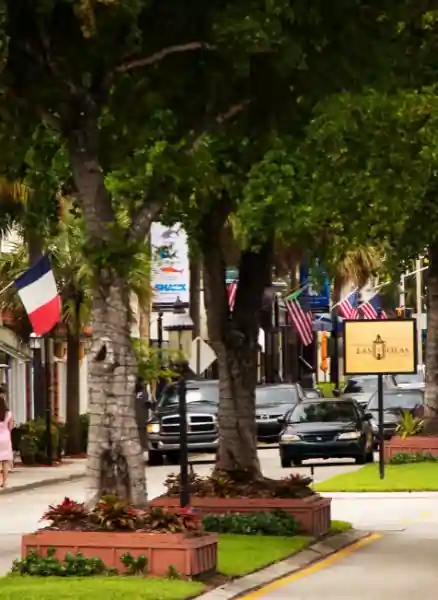
The black olive trees in the median didn’t suddenly decline.
From an arborist’s point of view, what we’re seeing is the result of long-term, cumulative stress.
Trees planted in street medians face some of the most difficult growing conditions possible:
- Extremely limited soil volume
- Heavy soil compaction
- Constant reflected heat from pavement
- Salt exposure from coastal air and roadway runoff
- Root conflicts with curbs, drainage, and underground utilities
A healthy canopy above ground depends on a healthy root system below ground.
When roots don’t have room to grow, trees become increasingly stressed over time.
And in a busy corridor like Las Olas – with pedestrians, outdoor dining, traffic, and events – that stress eventually can turn into a serious safety concern.
Why medians are one of the hardest places for large trees to thrive
This is something I see city planners and homeowners often overlook.
Large shade trees need space underground, not just room for branches overhead.
Roots need oxygen, moisture, and uncompacted soil to anchor the tree and support a full canopy.
In a narrow median, even well-established trees eventually get issues. And once that happens, the tree becomes more dependent on constant corrective pruning and risk management… but even then, the likelihood of failure is going to increase over time.
While the black olive trees on Las Olas add a lot of flair to the area, it was not the best species choice in my opinion.
Black olives have a shallow root system, which is bad for medians – and for South Florida in general – because of our sandy soils and our busy hurricane seasons.
Replanting medians is fine, as long as a native species with deep root systems are planted, such as Live Oaks for example.
What’s actually being proposed: fewer removals, many more replacements
One important detail that I feel often gets missed in the recent discussions is the scale of replacement planting being considered.
The proposal being discussed would remove roughly a dozen to fourteen mature black olive trees from the median, relocate a small number of ornamental trees, and then plant approximately 80 new canopy trees – most likely oak species – along the widened sidewalks.
So this isn’t about eliminating trees.
It’s about moving the canopy and significantly increasing the total number of trees along the corridor.
Of course, that doesn’t lessen the pain of those who are going to miss the beautiful, old trees. Because everyone knows that new trees take a long time to grow. And in the meantime, Las Olas Boulevard will inevitably lose some of its charm.
However, safety should be a bigger concern here than preserving an admittedly very characteristic and beautiful street look and feel.
Why shifting the canopy to the sidewalks does make sense
From a long-term tree care standpoint, sidewalk planting zones in my experience usually offer far better conditions than narrow medians – as long as they’re designed correctly.
Sidewalk plantings can provide:
- Greater soil volume for root growth
- Better access to irrigation and stormwater
- Easier long-term maintenance
- Stronger root anchoring against hurricane winds
The tradeoff, as mentioned before, is time.
Newly planted trees won’t provide the same immediate shade as mature median trees.
But with the right species and proper installation, they are far more likely to survive, mature, and provide sustainable canopy coverage over the next several decades.
Species selection matters
Not all trees respond the same way to urban stress.
Even though black olive trees aren’t a native tree species, they can perform well in certain settings. However, in highly constrained environments, they will inevitably struggle as they age.
My experience is that most streetscapes are better suited for smaller canopy species like pigeon plums, because of space constraints.
Larger species ultimately tend to fail when planted on sidewalks. Medians sometimes have a little more soil space for root growth.
As an arborist, my focus in regards to species selection is usually on whether:
- The tree is going to have enough room to grow
- The soil conditions are going to support root health
- The mature canopy size is going to match the space
When those factors line up, trees usually thrive.
But when they don’t, removal more often than not becomes unavoidable later on – no matter how iconic the tree might be.
Why this conversation feels so emotional – and why that’s understandable
Mature trees like the black olives on Las Olas always create some sense of identity and comfort.
When they’re being removed, it often feels like something irreplaceable is being taken away.
As an arborist, I know this better than anyone else and absolutely understand when homeowners want to hang on to an old tree.
And yes – it usually takes 10, 15, or even 20+ years for new plantings to recreate the same sense of shade, enclosure and that “cozy” feeling only old, mature trees can provide
That’s a very long time and thus it’s only understandable that such decisions spark pretty strong reactions.
What’s the alternative?
At the same time, it wouldn’t be responsible to keep trees in an environment where they’re becoming increasingly unsafe.
At the end of the day, public streets – even more so than private properties – need to first and foremost be safe, while still taking aesthetics and sustainability into account.
Tree deaths from breaking and falling limbs and branches are a real thing and cause over 100 deaths in the US every year.
No municipality would want to be accused of having neglected safety.
What Las Olas teaches homeowners and business owners
I see the same pattern on private properties all the time.
Trees that have been planted too close to pavement, buildings, or utilities often look fine for years – until problems surface.
By the time the decline is obvious, the options are often limited.
Las Olas is a public example of a private lesson: trees need long-term planning, not just short-term beauty.
That means:
- Choosing the right species for the space
- Investing in proper planting and soil preparation
- Evaluating trees early instead of waiting for visible decline
My professional takeaway
This isn’t a story about losing Fort Lauderdale’s tree canopy. It’s about redefining it in a way that actually works for the future.
Replacing a small number of stressed median trees with dozens of properly planted canopy trees has the potential to create a healthier, safer, and more resilient streetscape – even if the benefits take time to fully materialize.
As an arborist, I’d rather see trees that are given the space and conditions they need to thrive for decades than force mature trees to survive in environments that eventually make them unsafe.
Have questions about trees on your Fort Lauderdale property?
At Tree Motion, we offer professional tree care services in Fort Lauderdale.
If you’re concerned about a tree that’s declining, outgrowing its space, or becoming a potential safety issue, a professional evaluation can make all the difference.
Our goal is to help Fort Lauderdale residents understand:
- Which trees are worth preserving
- Which ones need corrective pruning
- And which ones are becoming genuine risks
If you’d like an honest, experience-based opinion, feel free to reach out.
We’re always happy to help you make informed decisions that protect both your property and Fort Lauderdale’s urban landscape.
Arturo Izquierdo
Arturo is an ISA-Certified Arborist and advisory board member for the University of Florida’s Commercial Horticulture program for Broward and Palm Beach County. With 20+ years of experience in the tree care industry, he provides expert guidance on tree care, risk assessment, and proper landscape practices. He is also the owner of Tree Motion LLC, a Fort Lauderdale based tree care company.