Arturo Izquierdo 4:42 pm No Comments
Why Tree Trimming Doesn’t Improve Tree Health
When homeowners call me, they often ask for “tree trimming”.
That’s the commonly used term for what we arborists do.
And it sounds great – like a quick tune-up.
Snip a little here, tidy a little there, and the tree will feel better… right?
Well…
Not exactly.
In professional arboriculture, we use the term pruning, not trimming.
Pruning is the deliberate removal of specific branches to meet a clear objective, and it is performed to an industry standard (ANSI A300) that defines how and why cuts are made.
“Trimming” and “cutting,” by contrast, are laymen’s terms and often imply indiscriminate or cosmetic cutting.
So why do we then label our service “tree trimming” on our website and not “tree pruning”? Well, simply because that’s how most people search for pruning. Using the word customers recognize helps them find the service they need.
But this is not about nitpicking over words.
Here’s the key truth:
Removing living branches always creates wounds and reduces your tree’s leaf area.
Therefore, pruning by itself won’t make any tree healther. On the contrary – any live-tissue removal is a stress the tree must overcome.
Below, I’m explaining why that’s the case, when pruning is warranted based on my experience, and how to do it responsibly under ANSI A300 tree pruning standards.
First principles: cuts are injuries, not a wellness treatment
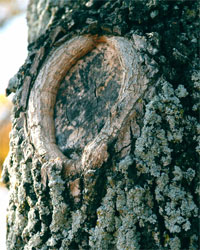
Every cut is a permanent wound.
Trees don’t “heal” like we do – they seal.
After a branch is removed, the tree walls off the injured wood through a defense process that we arborists often summarize as CODIT (Compartmentalization Of Decay In Trees).
This sealing response limits the spread of decay. But it also costs energy and time – and the wounded area never regains its original strength.
The branch collar at the base of the removed branch plays a key role in this process. It forms the protective tissue that helps the tree close over the wound.
In addition to costing the tree energy, removing live branches also reduces the tree’s photosynthetic engine (its leaves). And, as you can imagine, fewer leaves means less energy for growth, defense, root maintenance, etc.
That’s why topping and other aggressive “trimming” practices are frowned upon by professional arborists.
We consider these practices as amateurish as they are proven to be harmful for your trees. They increase stress, invite decay, and shorten your tree’s life expectancy rather than improving its healh.
So why do arborists prune at all?
It’s very simple: Because targeted pruning can reduce risk and manage conflicts better than doing nothing.
ANSI A300 (Part 1 – Pruning) sets the U.S. industry standard and requires that pruning has specific, stated objectives, such as:
Mitigating risk by removing dead, dying, or weakly attached limbs
Providing clearance from buildings, lights, or roadways
Improving structure in young trees to prevent future failures
Improving sightlines or pedestrian/vehicle access
Restoring a damaged crown after storms
The ANSI pruning standard also emphasizes selecting proper cuts (removal, reduction, or thinning) and preserving the branch collar to protect the tree’s defenses.
These are important considerations that us arborists always adhere to when performing any tree pruning.
In short:
Ok, this might have been a little bit technical.
So I’ll make this even easier to understand for you:
Prune only what is necessary, when it’s necessary, and in the right manner to minimize harm.
For a clear manual, see ISA’s “Pruning Mature Trees” guide, which states plainly that improper pruning can create lasting damage or shorten a tree’s life.
What responsible pruning looks like
Begin with an objective. For example, “reduce risk by removing deadwood ≥2 inches,” or “provide 3–4 feet of building clearance with reduction cuts.” ANSI A300 organizes work around objectives, not around taking a set percentage off “for looks.”
Use the right cut in the right place.
Removal cut: take a branch back to its point of origin, outside the branch collar (never flush).
Reduction cut: shorten to a lateral that’s large enough to assume the terminal role (typically ≥⅓ the diameter of the cut stem).
Thinning cut: selectively remove interior branches to reduce weight, not to “gut” the crown. Proper placement protects the branch collar and speeds natural closure.
Limit how much live crown you remove. Wholesale thinning to “let light in” or indiscriminate rounding-over removes too much foliage at once. It stresses the tree and spurs weak, fast-growing sprouts. A conservative approach, especially on mature trees, supports long-term stability.
Never top. Topping causes large wounds, decay, and a flush of poorly attached shoots that increase risk. Numerous industry resources caution against it for both safety and biology.
Skip wound dressings. Modern research and extension publications note that paints and sealers don’t stop decay and can even trap moisture; let the tree’s natural defenses do the work.
As you can see, doing pruning the right way can be more complex than one might think initially. But no worries, you can always hire a professional if you’re feeling overwhelmed.
When pruning helps – and when it doesn’t
Too often, inexperienced tree trimmers overdo it in their enthusiasm. In my experience, often less is more. Here’s when pruning is generally helpful, and when it isn’t:
Helpful (when necessary):
Deadwood removal to reduce risk and pest habitat.
Structural pruning on young trees to favor a single leader, good branch spacing, and strong attachments – small cuts early prevent big cuts later. (ISA Resource on pruning young trees)
Clearance or risk-reduction pruning around walkways, driveways, and roofs, using reduction cuts rather than heading cuts.
Not helpful:
Annual “trims” with no objective. Routine shaving of green tips “for neatness” removes energy without solving a problem.
Rounding-over and lion’s-tailing. Stripping inner foliage or creating a tight “ball” concentrates weight at branch ends and raises failure potential.
My Florida note: storm season is about structure, not shaving
Here in South Florida, the goal before hurricane season should always be to reduce risk – not to drastically thin trees.
Experienced arborists use well-executed reduction cuts to
- shorten over-extended limbs,
- remove dead, broken, or weakly attached branches,
- and lower the likelihood of breakage in wind.
Over-thinning, on the other hand, leaves too many branch tips exposed to the wind and I often see that it leads to weak new growth.
Bottom line
On many tree service company websites you’ll read something different, but my clear stance on the matter is that pruning does not “improve” tree health by itself.
More so, it’s a necessary harm we’re using sparingly to accomplish a specific goal with minimal stress to the tree.
Yes – if your tree has a clear need (risk, clearance, damaged wood, or early structural training), the right cuts, in the right places, at the right time can reduce hazards and set the tree up for long-term stability.
However, if there isn’t a clear need, routine “trimming” is more likely to drain energy and invite problems than to help.
If you’re unsure what your trees actually need, our ISA-credentialed team can evaluate them to ANSI A300 standards and recommend only the work that benefits the tree and your property’s safety.
If you’re curious, you can learn more about our professional tree pruning services here.
Arturo Izquierdo
Arturo is an ISA-Certified Arborist and advisory board member for the University of Florida’s Commercial Horticulture program for Broward and Palm Beach County. With 20+ years of experience in the tree care industry, he provides expert guidance on tree care, risk assessment, and proper landscape practices. He is also the owner of Tree Motion LLC, a Fort Lauderdale based tree care company.