Arturo Izquierdo 9:51 pm No Comments
Can Mature Trees Be Relocated? Tips for Fort Lauderdale Homeowners
Yes, many mature trees can be relocated. But not every tree is a good candidate, and success depends on much more than digging a large hole.
A proper mature tree relocation starts with an arborist evaluating the tree, its current location, the proposed new site, the travel path, local permit requirements, and the aftercare you can realistically provide.
As an ISA-Certified Arborist working in Fort Lauderdale and across South Florida, I look at relocation as a tree-preservation project. The goal is not simply to move a tree, but to give it a realistic chance of establishing safely in its new location.
For projects that require professional planning and equipment, see Tree Motion’s tree relocation services in Broward and Palm Beach County.
What Determines Whether a Mature Tree Can Be Moved?
I start with a few practical questions:
- Is the tree healthy enough to recover?
- Can we preserve an appropriate root ball?
- Is there enough access for the required equipment?
- Will the new site support healthy root growth?
- Can the owner commit to irrigation and follow-up care?
A tree with extensive decay, serious structural defects, major pest damage, or a failing root system may not be worth relocating.
Some species tolerate root loss and transplant shock better than others. Palm tree transplanting also differs from moving a broadleaf shade tree because palms produce and replace roots differently.
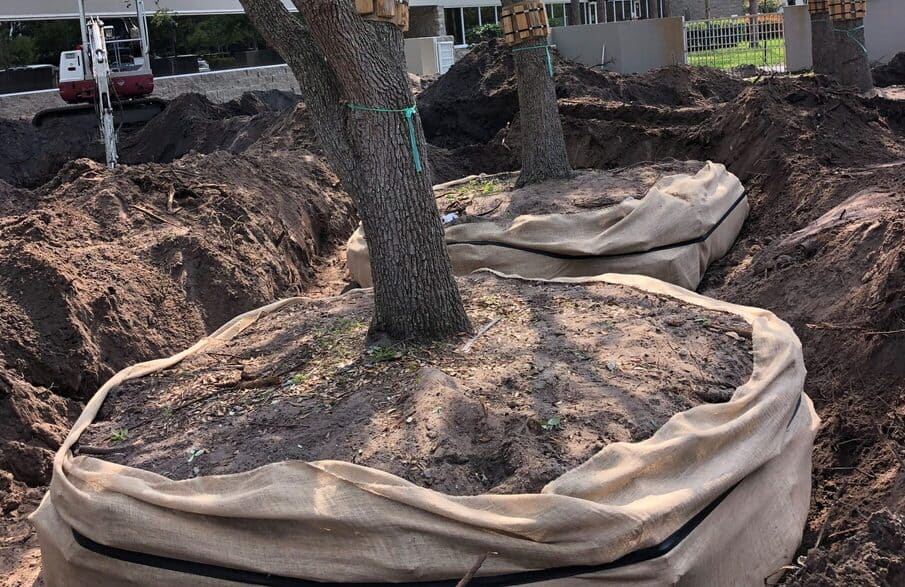
Most feeder roots lie outside the small area many people imagine as “the root ball.” Large tree transplanting therefore requires enough room to create and support a root ball appropriate for the tree and site.
Air excavation with an air spade can help. This tool uses compressed air to expose roots with less cutting than blind mechanical digging, especially where roots, irrigation lines, or hardscape are close together.
In Fort Lauderdale, sandy soils can drain quickly, while a high water table or compacted construction soil can keep a planting area too wet. The root flare must sit at the correct grade, and the receiving hole needs compatible drainage so water does not collect around the root ball and limit oxygen to newly recovering roots.
The crew needs utility locates for underground utilities, enough overhead clearance, and a workable route for a tree spade, crane, or other equipment.
Gates, pools, roofs, power lines, and narrow streets can change the plan or make relocation impractical.
How Professional Tree Transplanting Is Planned
1. Evaluate the tree and both sites
An arborist checks species, vigor, canopy balance, structural defects, decay, pest damage, root flare, drainage, and available rooting space.
We also consider the distance and route between the current location and the proposed new site.
2. Confirm permits and utilities
Fort Lauderdale regulates tree and palm relocation on public and private property. Review Fort Lauderdale’s tree permit process before work begins.
Requirements can differ elsewhere in Broward County, so the correct jurisdiction matters.
Before excavation, utility locates are essential. Overhead lines and road clearance also need to be addressed.
3. Prepare the roots when the schedule allows
For some projects, advance root pruning encourages new feeder roots closer to the trunk before the final move.
The timing and diameter of that work depend on the species, tree condition, root system, and available preparation period.
Root pruning should never be reduced to a generic formula.
4. Move and replant the tree carefully
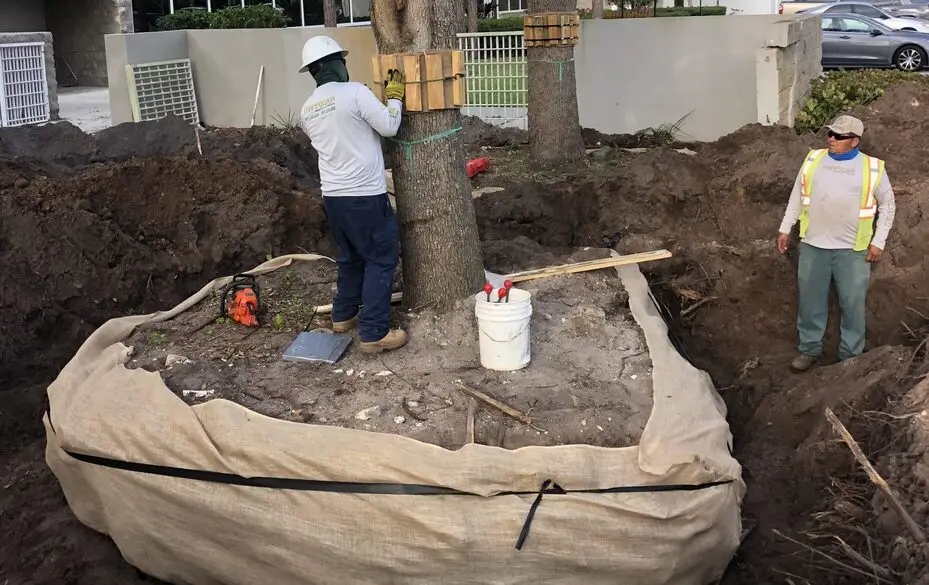
The crew excavates and secures the root ball, lifts the tree with equipment suited to the site, and transports it without unnecessary shock.
At the new site, the tree is positioned with the root flare at the proper elevation.
A crane may be required for a large tree or restricted access. A tree spade may suit other sites.
5. Stabilize and begin aftercare
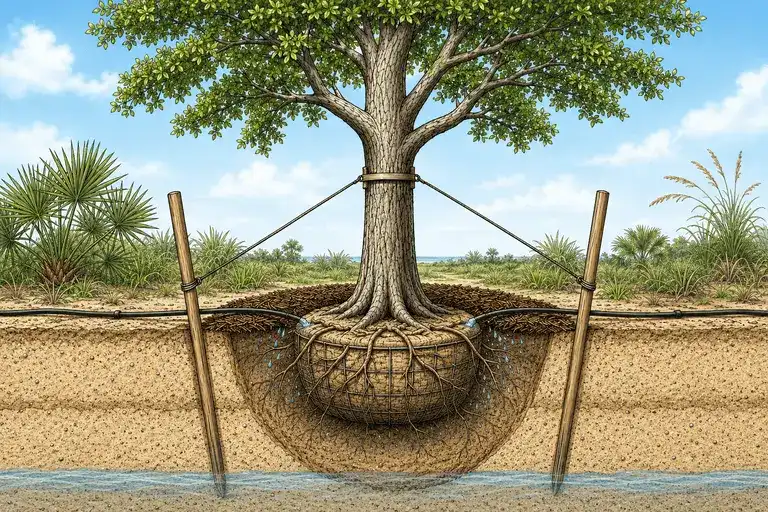
Staking may be needed when the root system cannot immediately resist wind.
Supports should not rub the trunk or remain indefinitely. A broad mulch layer helps conserve moisture, but mulch should stay away from the trunk and root flare.
The Establishment Period Is Where Success Is Won or Lost
Transplant shock is largely a water-balance problem. The tree has lost roots while its canopy continues to lose moisture.
Irrigation must be designed for the actual root ball, soil drainage, rainfall, and species.
Too little water allows the root ball to dry out. Too much water can reduce oxygen and lead to decline.
Soil moisture should guide the schedule rather than a fixed calendar alone.
Canopy pruning is not a substitute for proper root handling and irrigation.
UF/IFAS planting and establishment guidance advises against automatically pruning branches to compensate for root loss because shoot tips help drive root regeneration.
Pruning may still be appropriate for broken, dead, unsafe, or structurally unsound branches. Every cut should have a defined objective.
Regular inspections during the establishment period should track leaf or frond condition, soil moisture, stability, new growth, pests, decay, and support tension.
The larger the tree and the more roots lost, the longer recovery can take.
When Is the Best Time to Relocate a Tree in South Florida?
There is no single best month for every species.
South Florida does not give us the same predictable winter dormancy used for scheduling in colder climates.
I prefer to plan around species biology, irrigation capacity, soil conditions, and weather risk.
Avoiding the most stressful heat and drought is helpful. But moving a large tree immediately before hurricane season can create another risk if the root system has not re-established.
The right schedule is a project-specific decision, not a date copied from a national guide.
Can Relocation Be Better Than Removal?
Relocation can preserve shade, character, property value, and existing canopy when construction, a pool, drainage work, or a redesigned landscape conflicts with a healthy tree.
Fort Lauderdale’s tree-preservation rules may also make relocation an important alternative to removal.
But relocation is not automatically the responsible choice.
If a tree has serious decay, poor structure, an unsuitable destination, or no feasible excavation and transport route, replacement planting may offer a better long-term result.
Before finalizing construction or excavation plans, schedule an on-site relocation assessment. I can evaluate the tree, access, equipment needs, permit path, and aftercare requirements, then give you a clear recommendation.
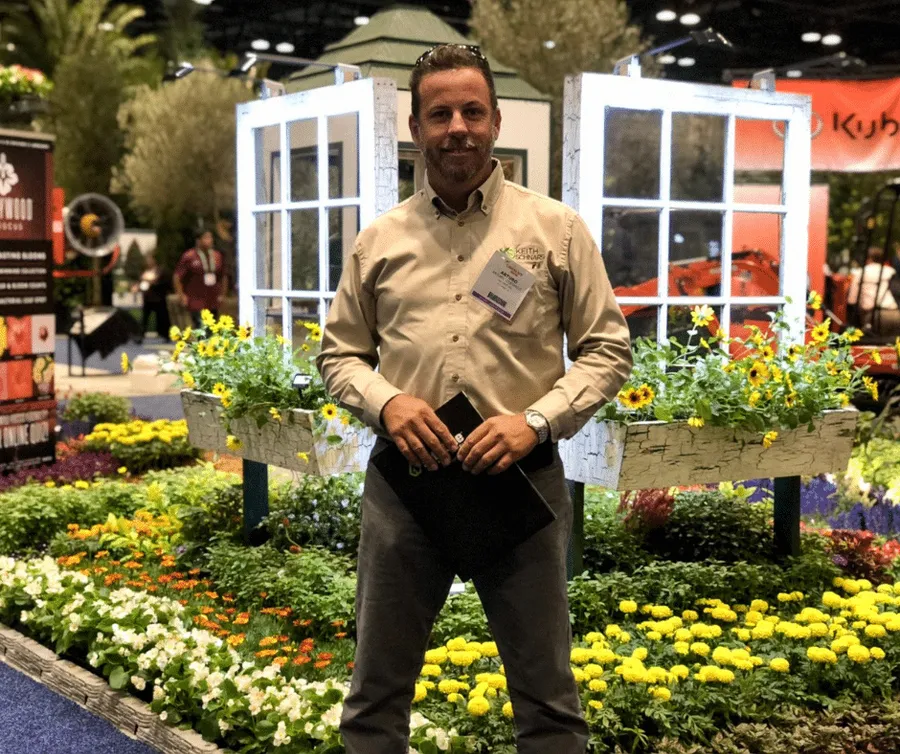
Arturo Izquierdo
Arturo is an ISA-Certified Arborist and advisory board member for the University of Florida’s Commercial Horticulture program for Broward and Palm Beach County. With 20+ years of experience in the tree care industry, he provides expert guidance on tree care, risk assessment, and proper landscape practices. He is also the owner of Tree Motion LLC, a Fort Lauderdale based tree care company.