Arturo Izquierdo 10:51 pm No Comments
Tree Removal Costs in Fort Lauderdale in 2026: A Local Arborist’s Pricing Guide
My name is Arturo Izquierdo, owner of Tree Motion LLC and an ISA-Certified Arborist with more than 20 years of hands-on South Florida tree-care experience.
In this pricing guide I’m going to give you my honest opinion on what realistic tree removal prices are in Fort Lauderdale in 2026.
This guide was written in July 2026, so if you’re reading it at a later time, you may want to adjust the prices upwards slightly for a more accurate reflection of current removal prices.
What Does Tree Removal Cost in Fort Lauderdale in 2026?
Tree removal pricing depends on tree size, condition, access, risk, equipment, debris hauling, and whether stump removal is included.
ProMatcher reported a Fort Lauderdale range of $402.80 to $498.20 for a standing tree under 30 feet, while HomeGuide published approximately $5 to $25 per foot and $300 to $2,000 for many trees measuring 30 to 80 feet; I’ve personally checked both of these sources on July 21, 2026.
These figures are planning benchmarks, not guaranteed local quotes.
My personal experience is that most professional companies are going to charge more towards the higher end of that, and for medium-sized and larger trees you’ll have to expect paying upwards of $1,000 if you want a professional company with proper insurance.
Also, when crane removal, controlled rigging, traffic management, or extensive hauling becomes necessary because you have a large tree near your home, then you should expect to pay $2,000 and more.
Either way, an on-site assessment is the only reliable way to evaluate structural defects and job-site constraints. That’s the same in South Florida as anywhere else.
Photographs rarely reveal trunk cavities, unstable roots, restricted equipment routes, or the full area exposed to any material that might be falling.
Also, in practice many professional tree care companies such as ourselves, have minimum day-rates. Most removal jobs easily meet those however.
A Word of Caution
Unfortunately many people are only looking for the cheapest option.
Throughout my career, I’ve seen many removal jobs gone wrong and it’s just not worth the risk, trying to save a few hundred dollars.
Tree work is dangerous, and removals can be especially dangerous. The safety of your home and property depends on hiring a professional company with proper insurance.
Clearly I am biased here, but I would advise anyone to hire a professional tree removal company over going with an amateur that may be cheaper upfront, but cost you more than you can afford if things go wrong.
Estimate Cost by Tree Size and Job Complexity
Tree height matters, but trunk diameter, canopy spread, tree lean, tree decay, and proximity to homes, pools, fences, driveways, and utility lines often matter more.
A shorter tree can cost more than a taller open-grown specimen when workers must lower every section without allowing branches or logs to fall freely.
The following size categories combine published comparison data with common local variables. They are useful for budgeting, but they cannot replace an inspection of the tree and surrounding property.
Small Trees Under 30 Feet
ProMatcher’s published Fort Lauderdale benchmark for a standing tree under 30 feet was $402.80 to $498.20 when I checked on July 21, 2026.
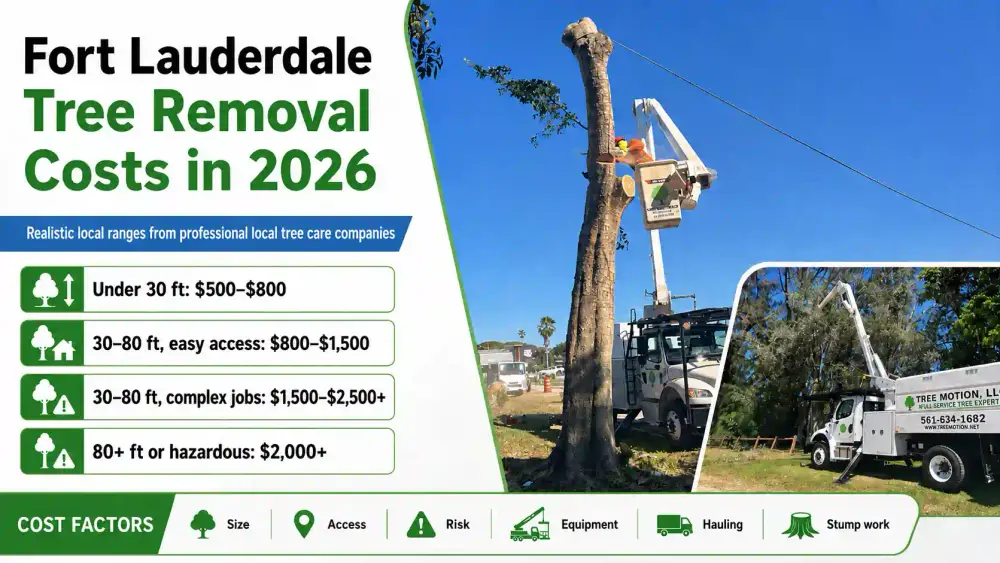
In my experience, that’s not too far off – however, costs are often closer to the $500 to $800 range if the tree is close to 30 feet tall, or if the removal situation is more complex.
Also, the costs can be higher than that if certain circumstances make the job more complex, dangerous, or laborsome.
Some factors that can play a role are:
- Gate width
- Branch spread
- Wood disposal
- Stump work
- Hauling requirements.
Medium Trees From 30 to 80 Feet
HomeGuide listed approximately $300 to $2,000 for many 30-to-80-foot removals and a broader comparison rate of $5 to $25 per foot when I checked on July 21, 2026.
These figures cover such a wide range because height alone rarely is the only thing that determines the final price.
No matter what you tree you have, if it’s over 30 feet you’re hardly going to get a $300 quote – and if you do, you should probably be concerned about the company’s qualifications.
In my experience, a more realistic range is $800 to $1,500 for easy tree removal in the 30-80 feet range, and $1,500 to $2,500+ for more complex and dangerous removal projects in Fort Lauderdale.
There’s a lot that can affect the estimate, like limited access, roof protection, pool-deck protection, and traffic management.
Backyard trees that cannot be reached by equipment may require workers to carry every branch and log section by hand.
These and other factors will determine the final price.
Large or Hazardous Trees Over 80 Feet
Trees approaching 100 feet are generally custom-priced because they may require a multi-person crew, tree rigging, cranes, bucket trucks, extended cleanup, and greater liability insurance exposure.
The removal plan must control substantially more weight across a larger fall zone.
A hazardous tree with cavities, broken leaders, severe decay, root movement, or a heavy lean may be unsafe to climb.
Proximity to utility lines adds another layer of coordination and can determine which equipment and qualified personnel may perform the work.
I wouldn’t trust any quote under $1,500 for such a removal project. Likely, you’re going to land well over $2,000 for a removal of a tree that’s over 80 feet tall or otherwise presents a big challenge.
What Changes the Final Tree Removal Price?
The principal cost drivers are tree condition, access, nearby targets, equipment requirements, hauling volume, and disposal.
Storm damage can raise costs because split or suspended sections behave less predictably than sound wood.
Fort Lauderdale properties also present sandy soils, narrow side yards, canals, dense development, salt exposure, and high storm-season demand.
These conditions affect root stability, equipment placement, scheduling, and the distance crews must move material.
Tree removal is not the same as tree pruning.
Removal normally involves dismantling the entire tree, controlling falling material, site cleanup, hauling, and possibly separate stump work, while selective pruning retains the tree and addresses specific branches.
Access, Equipment, and Protection Needs
Gate width, rear-yard access, parked vehicles, pavers, pool decks, and canal-side locations determine whether crews can use conventional equipment.
Restricted sites may require hand-carrying, additional rigging, a crane, or a bucket truck positioned away from the tree.
Do not trim near energized lines yourself:
Florida utility safety guidance says to keep people, tools, and ladders at least 10 feet away from power lines and contact the utility when a tree interferes with overhead lines. Utility vegetation work within an established electric right-of-way is also governed by Florida Statute 163.3209.
Stump Grinding, Hauling, and Cleanup
A written estimate should identify whether logs, brush, wood chips, final raking, and hauling are included. Otherwise, a low removal price may leave the property owner responsible for a large volume of material.
Stump grinding is commonly priced separately because stump diameter, root flare, machine access, desired grinding depth, and underground utilities affect labor. Irrigation pipes and low-voltage lighting should be identified before grinding begins.
Check Permits and Tree Rules Before Scheduling Work
Property owners should verify current City of Fort Lauderdale tree-preservation requirements before authorizing removal. Under the Fort Lauderdale tree-preservation code, permit thresholds depend on property type, species, and redevelopment status: on non-one-family residential property, dicot or conifer trees measuring 3 inches or more in diameter and monocots with 8 feet or more of wood require a permit.
On a developed one-family lot with no redevelopment anticipated, the permit threshold for a dicot or conifer is 8 inches in diameter measured 4.5 feet above grade; certain Cocos, Roystonea, and Phoenix palms with 8 feet or more of wood are also regulated. The City’s tree permit submittal information requires species or common name, trunk diameter at chest height, condition rating, and the proposed status of each tree.
Properties outside Fort Lauderdale’s municipal boundaries may follow Broward County rules or another municipality’s code. The governing jurisdiction, not the property’s mailing address alone, determines the applicable process.
Before scheduling work, confirm applicable licensing, insurance, workers’ compensation coverage, and permit responsibilities. For City of Fort Lauderdale work, contractors must register through LauderBuild and provide a state license or county certificate of competency, liability insurance, and workers’ compensation proof or an exemption; insurance certificates must name the City as certificate holder.
For more information about when you might need a tree removal permit, you may read my guide on tree removal permits in Fort Lauderdale.
Protected Trees and Documentation
Fort Lauderdale’s tree-preservation ordinance requires a replacement tree or equivalent value when a protected tree is removed, with replacement planting based on site feasibility and adequate room for mature canopy spread. When replacement trees are required, the ordinance calls for the largest tree reasonably available on the site.
A tree that appears hazardous is not automatically exempt from local rules. Photographs, measurements, an arborist’s findings, and direct municipal confirmation create a defensible record before work begins.
How to Compare Tree Removal Estimates Fairly
Obtain written, itemized estimates after an on-site visit and compare identical scopes. Homeowners reviewing tree removal services in Fort Lauderdale should verify the following items:
- Number and location of trees
- Removal and lowering method
- Equipment and site protection
- Debris and wood hauling
- Stump grinding
- Permit responsibility and fees
- Replacement-tree obligations
- Final site cleanup
- Explicit exclusions
An unusually low bid may omit insurance, disposal, cleanup, or equipment needed to control heavy sections near structures. The meaningful comparison is the total completed scope, not the first number shown.
Questions to Ask Before Approving a Quote
Ask what is included, what conditions could change the price, and whether stump grinding is separate. The contractor should also explain how crews will protect roofs, fences, landscaping, pavers, pools, and neighboring property.
Request proof of insurance and clarify responsibility for permits, replacement trees, and inspection documents. Emergency work, after-hours mobilization, crane charges, and traffic control should be identified as included or excluded.
Frequently Asked Questions
How Much Does It Cost to Have a 100-Foot Tree Removed?
A 100-foot tree is generally custom-priced because cranes, bucket trucks, advanced rigging, multiple crew members, traffic control, and substantial hauling may be necessary. Its condition and location can influence cost as much as its height.
What Is the Average Cost to Remove a Tree in Fort Lauderdale?
HomeGuide publishes broad estimates of about $5 to $25 per foot and $300 to $2,000 for many 30-to-80-foot trees. Fort Lauderdale access, risk, permits, equipment, and cleanup requirements can materially change the final estimate. In my professional experience, tree removal quotes in Fort Lauderdale realistically range between $500-800 for trees under 30 feet, and from $800-2,000 for taller trees and more complex removal situations.
Can Seniors Get a Tree Removed for Free?
No general free tree-removal program for seniors on private property is documented in the available Fort Lauderdale or Broward County sources. Broward’s Chip-A-Tree Program applies only to residents who bring undecorated holiday trees to participating parks for chipping.
How Big Does a Tree Need to Be to Cost $1,000 to Remove?
A $1,000 removal is not tied to one tree height. A medium tree near a roof or pool with limited access may reach that amount, while a similarly sized tree in an open area may cost less.

Arturo Izquierdo
Arturo is an ISA-Certified Arborist and advisory board member for the University of Florida’s Commercial Horticulture program for Broward and Palm Beach County. With 20+ years of experience in the tree care industry, he provides expert guidance on tree care, risk assessment, and proper landscape practices. He is also the owner of Tree Motion LLC, a Fort Lauderdale based tree care company.